Res Dev Med Educ.14 :33315.
doi: 10.34172/rdme.025.33315
Original Article
The Mediating role of L2 motivation in the relationship between time orientation and procrastination among medical ESP students
Rana Sojodizadeh Data curation, Investigation, Project administration, Writing – original draft, 1 
Saeideh Ahangari Conceptualization, Resources, Supervision, Writing – review & editing, 2, *
Masoud Zoghi Methodology, Software, 1
Author information:
1Department of English, Ahar Branch, Islamic Azad University, Ahar, Iran
2Department of English, Tabriz Branch, Islamic Azad University, Tabriz, Iran
Abstract
Background:
In addition to memory and attention, several key elements influence language acquisition, including procrastination, motivation, and time orientation. These factors can significantly affect the success or failure of language education programs.
Methods:
This study examined the complex relationships between time perspectives, motivation, and procrastination among medical English for Specific Purposes (ESP) students. A total of 200 medical students (male and female) aged 18-25 from Tabriz University of Medical Sciences were selected through stratified sampling. They were studying in their fourth and fifth semester of education and they were at the upper intermediate and advanced language proficiency based on their language scores. Data collection instruments included the Zimbardo and Boyd time perspective scale by the reliability index of 0.78, Aitken procrastination scale having the reliability index of 0.88, and Gardner motivation test battery with a reliability index of 0.71, and validity ensured. For testing the hypotheses of the study, correlational analysis and structural equation modeling (SEM) was used and the most appropriate index for considering the fitness of model in this method is goodness of fit (GOF) and as the amount of GOF in this study came to 0.43 which is above 0.4, so it met the accepted thresholds and the SEM adequacy was confirmed.
Results:
The results indicated that different dimensions of time perspective had distinct effects on motivation and procrastination. Furthermore, motivation played a mediating role in the relationships between time perspectives and procrastination.
Conclusion:
The findings have important theoretical and practical implications for ESP teachers, psychologists, teacher educators, and medical students, highlighting the significance of understanding the interplay between time orientation, motivation, and procrastination in language acquisition.
Keywords: ESP, Motivation, Medical students, Procrastination, Structural equation modeling (SEM), Time orientation
Copyright and License Information
© 2025 The Author(s).
This is an Open Access article distributed under the terms of the Creative Commons Attribution License (
http://creativecommons.org/licenses/by/4.0/), which permits unrestricted use, distribution, and reproduction in any medium, as long as the original authors and source are cited. No permission is required from the authors or the publishers.
Funding Statement
None.
Introduction
English for Specific Purposes (ESP) is a learner-centered approach to language teaching that emphasizes addressing the unique objectives, needs, and contexts of individual learners.1-3 Given the importance of tailoring ESP curricula to learners’ distinct goals and circumstances, there is a growing demand for comprehensive needs analyses to guide the development of relevant, effective language programs.4 This is particularly crucial in the medical area, where English has been the common language in communicating main concepts, publishing research, and engaging with the international community.5,6 While medical students and professionals must develop good command of English, research indicates they often face significant language learning challenges,3,7,8 underscoring the need for further examination of the factors that contribute to their English language development.
Time orientation is a fundamental aspect of how people construct their psychological experience of time. It comes from the cognitive processes that divide human experiences into past, present, and future temporal frames. Studies on this psychological dimension of time, known as “time perspective”, has increased significantly in recent years.
Another significant parameter in learning and proper achievement on English language learning for medical students is procrastination which is characterized as a self-sabotaging tendency whereas procrastinators are often characterized as lethargic individuals who have tendency to waste time and demonstrate poor performance.9,10
Educational attainment or language achievement is the result of the learning process, which reflects the degree to which a student, educator, or educational institution has met their academic objectives.11 Research has consistently shown a strong relationship between student motivation and academic/language achievement. Since motivation influences both the processes and outcomes of acquiring a new language, the mediating role of motivation in language learning is critical. Motivation acts as a crucial psychological bridge that connects learners’ personal goals and aspirations with their engagement in language-related activities.12 According to Dörnyei,13 motivation can significantly affect learners’ persistence, effort, and overall achievement, thereby mediating the relationship between individual characteristics and language proficiency. For instance, intrinsic motivation—stemming from a genuine interest in the language—can enhance learners’ persistence in the face of challenges, while extrinsic motivation, driven by external rewards or recognition, may push learners to perform well in assessments. Furthermore, the dynamic interplay of motivation with other factors, such as self-efficacy and learning environment, underscores its mediating role. Ultimately, understanding how motivation functions within the language acquisition framework can inform effective instructional strategies that cater to diverse learner needs and promote sustained engagement in language learning. Research studies have shown that both intrinsic and extrinsic motivation are positively associated with higher levels of language competency and academic achievement.14-16 Specifically, greater motivational drive leads students to put forth more effort towards their academic goals. Conversely, procrastination has been linked to lower levels of motivation, which in turn negatively impacts language achievement.17 Procrastination is often associated with increased anxiety, such as test anxiety and social anxiety, which can further undermine academic success.18,19
Despite the growing body of research on ESP and the importance of addressing the unique needs of medical students, there is a notable lack of studies specifically examining the interplay between time orientation, procrastination, and motivation in the context of medical English language learning in Iran. While previous research has explored various aspects of language acquisition and the challenges faced by medical students, there is insufficient investigation into how these psychological factors contribute to their English language proficiency and academic success. The purpose of this study is to investigate the relationships between time orientation, procrastination, and motivation among medical ESP students in Iran. By examining how these factors influence English language learning, the study aims to provide insights that can inform the development of tailored instructional methods and curricula to enhance the language proficiency and academic achievements of medical students. To fulfill the purposes of the study, the following research questions were formulated:
Are there any significance relationship between time orientation (future, past negative, past positive, present fatalistic, present hedonistic) and procrastination of ESP learners with the contribution of motivational system?
The following hypothesis was formulated:
There are some significant structural relationships between time orientation (future, past negative, past positive, present fatalistic, present hedonistic) and procrastination of ESP learners with the contribution of motivational system.
Literature Review
Lewin20 defined time perspective as an individual’s psychological views of their past and future. Carstensen et al21 argued that this perception significantly influences social goals and affects emotions, motivation, and cognition, with expected cross-cultural differences.22,23 Despite its importance, time perspective (TP) is underexplored in psychology. Zimbardo and Boyd24 advocate for its inclusion in research. Cyril11 found a significant link between time orientation and academic achievement among higher secondary students, while Nasrullah and Khan25 reported a strong correlation between time orientation and language success in university students, suggesting that effective time management can enhance academic performance.
Rothblum et al26 define procrastination as delaying academic tasks to the point of causing distress. In language achievement, it can lead to reduced success, worsened psychological issues, and lower self-esteem among medical students.27,28 Contributing factors include stress, poor time management, lack of self-regulation, and fear of failure.29 Although procrastination can sometimes be harmless, it often hinders personal development and goal achievement.11,30 Kazemi et al31 highlight that the underlying reasons for procrastination remain unclear, resulting in conflicting findings.
In the context of second and foreign language acquisition, research suggests that different types of motivation can impact the learning process in distinct ways. Two main types of motivation are typically distinguished as instrumental motivation which refers to wanting to learn a language for practical, goal-oriented purposes, such as getting a job, reading foreign media, or passing an exam. The goal is to use the language as a tool to achieve certain instrumental objectives. Another type is integrative motivation which refers to wanting to learn a language in order to integrate with and communicate more closely with the culture and people who speak that language. The goal is to become part of the target language community.
Gardner32 highlights the necessity of considering educational and cultural contexts to understand second language learning motivation, distinguishing it from motivation in other academic areas. Most language teachers agree that motivation is crucial for success in language acquisition.33 Furthermore, research indicates that a student’s communication skills and their management of free time significantly influence their motivation and engagement in the learning process.34
Research on college students’ procrastination behaviors reveals significant delays in academic tasks. Solomon and Rothblum26 reported that students procrastinated on writing term papers (46%), studying for exams (27.6%), and completing weekly reading (30.1%). This phenomenon, known as academic procrastination, is defined by Steel and Klingsieck35 as the voluntary delay of intended academic activities despite anticipated negative outcomes. The terms “student procrastination” and “academic procrastination” are often used interchangeably.9
Studies examining the link between procrastination and language achievement present conflicting findings. While some research36,37 indicates that procrastination does not negatively affect academic performance, other research38,39 suggests it can adversely impact learning outcomes. Kim and Seo40 pointed out that variations in these findings might be attributed to small sample sizes and differences in participant demographics.
Steel41 categorized factors associated with procrastination into four areas: task-related features, individual differences, outcomes, and demographic variables. Individual differences include traits like neuroticism, extraversion, and conscientiousness, while task characteristics relate to the nature of the work. Procrastination can negatively affect mood, performance, and anxiety levels. Lee42 linked high levels of procrastination to low motivation and a lack of flow state. Kandemir43 found a significant negative relationship between academic motivation and procrastination, and Çavuşoğlu and Karataş44 identified both intrinsic and extrinsic motivation as predictors of procrastination. Additionally, Bekleyen9 reported a negative correlation between students’ satisfaction with their academic programs and their procrastination rates. Mahmoodi and Haddad Narafshan5 explored identity types and attitudes toward language learning among medical sciences students. They found that a stronger sense of identity correlates with more positive attitudes toward learning English, particularly regarding career advancement and technological proficiency. The study highlights the need for further investigation into the English language needs of Iranian medical students to address academic dissatisfaction and to develop relevant medical English courses and teaching strategies tailored to their unique needs.
Methods
Participants
In order to gather the required data, a total of 200 medical students (male and female) within the age range of 18-25 enrolled at Tabriz University of Medical Sciences were selected via Stratified sampling method. Dividing the population into strata (groups) before sampling enabled the researcher to obtain more precise estimates of the population parameters. This is particularly important in studies where the characteristics of different groups may influence the results. These students have a 3-credit professional English course as a part of their medical curriculum. Their first languages were Azari Turkish and Persian. This study followed BERA’s45 ethical guidelines; participants were informed of the research aims and consented to participate. They were informed of the likelihood of publication and were offered anonymity and the opportunity to question, comment on, and withdraw from the research. This study was conducted in Tabriz Medical University of Science, all of the stakeholders, faculty members, teachers and students were informed and the required permissions were obtained. Since the scores of the course were part of their curriculum, all the participants attended the study and nobody was excluded.
Instruments
In order to investigate the role of time orientation, and motivation on the procrastination among ESP Medical students, three questionnaires were utilized. The first part of data collection procedure consists of demographic inventory and accordingly some characteristics of participants such as age, gender, birthplace and native language were investigated.
Motivation questionnaire
In order to assess participants’ language learning motivation, a 5-point Likert motivation scale adapted from the original 7-point format of Gardner’s32 Attitude/Motivation Test Battery (AMTB) was utilized. The questionnaire was divided into two main sections - the first 10 items focused on instrumental motivation, while the final 10 items assessed integrative motivation.
Time orientation
The ZTPI is a 56-item measure developed by Zimbardo and Boyd that assesses five different time perspective subscales:
-
Past Negative - Focuses on negative past experiences and events.
-
Past Positive - Reflects on happy memories and positive past occurrences.
-
Present Hedonistic - Emphasizes living in the moment and seeking excitement/pleasure.
-
Present Fatalistic - Indicates a belief that the future cannot be planned due to constant change.
-
Future - Demonstrates an ability to delay gratification and focus on future goals and work.
Each subscale contains between 9-14 items, and respondents rate the items on a 5-point Likert scale. Initial reliability testing showed that the Cronbach’s alpha for each item ranged from 0.70 to 0.80, indicating the questionnaire has robust internal consistency.
Procrastination test
A procrastination questionnaire—adapted from Aitken and Academic procrastination scale developed by Çakıcı—wasused for considering the causes of destructive procrastination. It consists of 16 items which
employs 5-points Likert scale varying from 1 strongly agree to 5 strongly disagree.
Procedure
In order to verify the structural relationship between time orientation, and procrastination with the mediating role of motivation, this study investigated around 200 Iranian ESP students. To this end, the participants were asked to fill out the related questionnaires. The study was conducted in two phases: data collection, data analysis.
Data collection
In educational research, sampling which is representative of the target population is one of the most important steps. To draw the sample, probability sampling was used. Probability sampling uses random sampling techniques to create a sample and is based on the fact that every member of a population has a known and equal chance of being selected.46 The types of probability sampling most frequently used in educational and social research include simple random sampling, cluster sampling, stratified sampling, multi-stage random sampling, and systematic sampling. Sampling method in the present study was Stratified sampling.
The sample size in each of these levels was considered as representative of the entire target level population. So, to determine the sample size, of population, the appropriate sample size was calculated based on the properties of the population. In doing so, Cochran’s formula was used to estimate the appropriate sample size of population. Prior to the main study, a preliminary pilot study was conducted on a small group of participants. The purpose of this pilot study was to identify any potential issues or challenges that could arise and potentially impact the outcomes of the larger, main research study. By proactively addressing any problems identified in the pilot phase, the researcher could work to mitigate those factors and optimize the success of the main study. Therefore, as for data collection procedure in this study, the questionnaires were selected and reviewed by three experienced university experts to decide whether it needed to be refined before carrying out the main study and also to determine the amount of time needed to fill in the questionnaire. In the present study, the questionnaires were piloted with a very smaller sample (N = 30) from medical school. The items within the questionnaires used in the study should be considered to have adequate internal consistency. To measure the reliability of the research instrument, the researchers calculated Cronbach’s alpha, which is a statistical metric used to assess the internal consistency of a scale or set of items. The data collected in the pilot study to assess the reliability was computed by SPSS version 20. Since this study was in the Iranian context, the content validity with regards to this context was examined by ELT experts in Iran. The questionnaire items were developed based on sources that provided an English language version of the content. In this research process, no translation into the participants’ primary language of Persian was necessary. This is because the wording and phrasing of the questionnaire items was already adjusted to align with the level of English proficiency of the participants, who ranged from upper-intermediate to advanced English speakers.
The researcher recruited participants from the medical school in Tabriz by directly contacting the school and requesting assistance from the English teachers there. They were both male and female students and in their fourth and fifth semester of education. They have just finished their ESP course. However, the actual distribution of the questionnaires was only done after receiving official permission from the school authorities. All of the research instruments were administered to the participants by their regular English as a Foreign Language (EFL) teachers. Before the teachers distributed the surveys, the researcher provided them with information about the purpose of the study and instructions on how to guide the participants in completing the questionnaires properly.
At the beginning or end of regular instructional time, the researcher spent 20-30 minutes to distribute questionnaires among the students and read a short description of the study procedures which includes a statement that students could decline participation or answering any questions that made them feel uncomfortable. They informed the students that through these tests, they could gain genuine information on some of their personal tendencies, and upon completion of the questionnaires, they obtained class credit for participation. The administration procedures followed the regular accommodation procedures used with the students. The participants were instructed to select the response option that best reflected their own characteristics and perspectives when answering the questionnaires. Participation was voluntary, and the anonymity and confidentiality of the participants were ensured - the collected data was treated as private and participants’ names were not disclosed.
After explaining the questionnaire items and clarifying any problem areas, the participants proceeded to fill out the scales. Any incomplete, invalid, or suspicious responses were marked and excluded from the data analysis. The remaining valid responses were then used as inputs for the data analysis.
Data analysis
Data analysis is a scientific method and one of the fundamental bases of every research which helps summarize, codify, categorize and process the data collected from the sample. It is used to facilitate the analysis and relationship(s) between the bits of collected raw data.
Initially, the Cronbach’s alpha coefficients were computed to estimate the internal consistency estimate of reliability of four questionnaires. Then, the data collected by means of questionnaires were explored using a correlation analysis and structural equation modeling (SEM). The software package SPSS 24.0 and Amos 8 were used for descriptive statistics and correlation analyses, respectively and the report was presented in descriptive and inferential formats. Descriptive statistics was used to display the mean scores and the standard deviations of the variables (i.e., time orientation, procrastination, goal- orientation, foreign language motivation).
The mediating paths was evaluated using SEM technique. However, before doing this, the data were examined to avoid any possible errors. In the first stage, a description of population participating in the study was presented. In the second stage, analysis of responses to the questionnaires was done.
Results
Hypothesis testing
In this section, the research hypotheses are tested using the SEM approach. In SEM, two main modeling techniques can be employed – covariance-based SEM (CBSEM) and variance-based SEM. In the CBSEM approach, the objective is to minimize the discrepancy between the theoretical covariance matrix and the observed covariance matrix in the sample. Maximum likelihood estimation and generalized least squares methods are typically used for this purpose. This approach requires the fulfillment of certain assumptions, such as normal distribution of observed variables and a reasonably large sample size. When the assumptions for CBSEM are violated, such as non-normal distribution of variables, an alternative approach is the use of partial least squares (PLS-SEM). Before testing the research hypotheses, the assumptions of the partial least squares (PLS-based) SEM method are first examined for the research model. These include the assessment of multicollinearity, reliability of individual items, composite reliability of each construct, and average variance extracted (AVE). The hypothesis for the study is: There are some significant structural relationships between time orientation (future, past negative, past positive, present fatalistic, present hedonistic) and procrastination of ESP learners with the contribution of motivational system.
To examine the absence of multicollinearity, the variance inflation factor (VIF) test is used. The VIF assesses the degree of multicollinearity in ordinary least squares regression analysis. If the VIF statistic is close to 1, it indicates the absence of multicollinearity. As a rule of thumb, if the VIF value is greater than 5, it suggests high multicollinearity. The results of the VIF test are presented in Tables 1 to 3. Based on the findings, the VIF values for none of the items are greater than 5. Therefore, for testing the research model, the issue of multicollinearity does not exist. Given that the statistical distribution of some of the variables in this study is not normal, the PLS-SEM method is employed to test the research hypotheses. All the analyses have been conducted using the SmartPLS 3 software. To assess the validity of each item, the absolute value of the outer loading of each item in the confirmatory factor analysis should be 0.4 or greater, indicating a well-defined construct. Additionally, the factor loadings of the items must be significant at least at the 0.05 level, meaning the absolute value of the t-statistic should be greater than 2.58.47 It is important to note that if the absolute value of an item’s factor loading is less than 0.4, it is recommended to remove that item. Tables 1 to 3 present the absolute values of the factor loadings for the items related to the questionnaires used in the research. Based on the results in these tables, the absolute values of the factor loadings for all the items are greater than 0.4, and the absolute values of the corresponding t-statistics are greater than 2.58. Therefore, the items of these questionnaires demonstrate sufficient reliability.
Table 1.
Absolute values of factor loadings, t-statistics, and VIF index for the items related to the Time Orientation questionnaire
|
Itemcode
|
Item
|
Outer Loadings
|
T Statistics
|
VIF
|
| Toq1 |
I do things impulsively. |
0.4 |
5.05 |
1.2 |
| Toq2 |
When listening to my favourite music, I often lose all track of time. |
0.5 |
2.6 |
1.1 |
| Toq3 |
I try to live my life as fully as possible, one day at a time. |
0.6 |
13.2 |
1.3 |
| Toq4 |
Ideally, I would live each day as if it were my last. |
0.4 |
6.2 |
1.3 |
| Toq5 |
I make decisions on the spur of the moment. |
0.5 |
8.3 |
1.3 |
| Toq6 |
Taking risks keeps my life from becoming boring. |
0.4 |
7.3 |
1.2 |
| Toq7 |
The past has too many unpleasant memories that I prefer not to think about. |
0.5 |
6.2 |
1.08 |
| Toq8 |
I take risks to put excitement in my life. |
0.4 |
4.9 |
1.1 |
| Toq9 |
Fate determines much in my life. |
0.6 |
5.4 |
1.1 |
| Toq10 |
Often luck pays off better than hard work. |
0.5 |
4.8 |
1.08 |
| Toq11 |
You can't really plan for the future because things change so much. |
0.7 |
7.7 |
1.2 |
| Toq12 |
My life path is controlled by forces I cannot influence. |
0.5 |
5.9 |
1.1 |
| Toq13 |
I often think of what I should have done differently in my life. |
0.4 |
4.2 |
1.07 |
| Toq14 |
I've made mistakes in the past that I wish I could undo. |
0.6 |
6.4 |
1.2 |
| Toq15 |
It's hard for me to forget unpleasant images of my youth. |
0.6 |
5.9 |
1.2 |
| Toq16 |
I think about the bad things that have happened to me in the past. |
0.5 |
5.3 |
1.2 |
| Toq17 |
I think about the good things that I have missed out on in my life. |
0.5 |
2.6 |
1.1 |
| Toq18 |
Painful past experiences keep being replayed in my mind. |
0.4 |
3.7 |
1.1 |
| Toq19 |
I often follow my heart more than my head. |
0.4 |
7.05 |
1.1 |
| Toq20 |
Happy memories of good times spring readily to mind. |
0.4 |
3.5 |
1.2 |
| Toq21 |
Spending what I earn on pleasures today is better than saving for tomorrow's security. |
0.5 |
3.9 |
1.2 |
| Toq22 |
I like my close relationships to be passionate |
0.5 |
7.5 |
1.1 |
| Toq23 |
Familiar childhood sights, sounds, smells often bring back a flood of wonderful memories. |
0.6 |
8.7 |
1.2 |
| Toq24 |
It gives me pleasure to think about my past. |
0.6 |
9.04 |
1.3 |
| Toq25 |
On balance, there is much better to recall than bad in my past. |
0.6 |
8.6 |
1.2 |
| Toq26 |
My decisions are mostly influenced by people and things around me. |
0.5 |
3.3 |
1.2 |
| Toq27 |
I've taken my share of abuse and rejection in the past. |
0.6 |
2.9 |
1.1 |
| Toq28 |
I get nostalgic about my childhood. |
0.6 |
8.1 |
1.2 |
| Toq29 |
Even when I am enjoying the present, I am drawn back to comparisons with similar past experiences. |
0.5 |
3.8 |
1.2 |
| Toq30 |
I complete projects on time by making steady progress. |
0.5 |
3.9 |
1.1 |
| Toq31 |
When I want to achieve something, I set goals and consider specific means for reaching those goals. |
0.4 |
3.1 |
1.2 |
| Toq32 |
I meet my obligations to friends and authorities on time. |
0.4 |
3.6 |
1.2 |
| Toq33 |
I believe that a person's day should be planned ahead each morning. |
0.5 |
5.9 |
1.1 |
| Toq34 |
I am able to resist temptations when I know that there is work to be done. |
0.7 |
10.08 |
1.3 |
| Toq35 |
I like family rituals and traditions that are regularly repeated. |
0.5 |
6.9 |
1.08 |
| Toq36 |
I keep working at difficult, uninteresting tasks if they will help me get ahead. |
0.7 |
14.7 |
1.3 |
Table 2.
Absolute values of factor loadings, t-statistics, and VIF index for the items related to the Motivation questionnaire
|
Item code
|
Item
|
Outer loadings
|
T statistics
|
VIF
|
| Mq1 |
I mainly focus on using English for class assignment and the exams. |
0.538 |
6.403 |
1.517 |
| Mq2 |
I simply quote the textbooks and do not really communicate myself when speaking or writing in class. |
0.621 |
6.036 |
1.757 |
| Mq3 |
I am interested in reading only English textbooks for my university study, but not other English texts e.g., newspapers, magazines. |
0.651 |
6.211 |
1.889 |
| Mq4 |
I am more interested in earning a university degree and a good job than learning English language itself. |
0.624 |
6.818 |
2.127 |
| Mq5 |
I am more interested in furthering my higher education than learning English language itself. |
0.535 |
7.719 |
1.783 |
| Mq6 |
Learning English is important for travelling abroad. |
0.542 |
3.024 |
1.915 |
| Mq7 |
Learning English is important for making me a knowledgeable and skillful person. |
0.473 |
3.094 |
2.622 |
| Mq8 |
Learning English is important for making me an educated person. |
0.462 |
3.134 |
2.253 |
| Mq9 |
Being proficient in English can lead to more success and achievements in life. |
0.460 |
3.834 |
1.788 |
| Mq10 |
Being proficient in English makes other people respect me. |
0.413 |
3.230 |
1.586 |
| Mq11 |
Studying English enables me to understand English books, movies, pop music etc. |
0.527 |
3.039 |
2.229 |
| Mq12 |
Studying English enables me to better understand and appreciate the ways of life of native English speakers. |
0.679 |
3.976 |
2.035 |
| Mq13 |
Studying English enables me to keep in touch with foreign acquaintances. |
0.420 |
4.218 |
1.785 |
| Mq14 |
Studying English enables me to discuss interesting topics in English with the people from other national backgrounds. |
0.557 |
3.854 |
1.796 |
| Mq15 |
Studying English enables me to transfer my knowledge to other people e.g., giving directions to tourists. |
0.404 |
4.334 |
1.835 |
| Mq16 |
Studying English enables me to participate freely in academic, social, and professional activities among other cultural groups. |
0.545 |
3.175 |
1.812 |
| Mq17 |
Studying English enables me to behave like native English speakers: e.g., accent, using English expressions. |
0.674 |
4.460 |
1.610 |
| Mq18 |
Studying English enables me to appreciate English arts and literature. |
0.445 |
5.406 |
2.014 |
| Mq19 |
Studying English helps me to be an open-minded, and sociable person like English speaking people. |
0.431 |
3.466 |
1.665 |
| Mq20 |
I am determined to study English as best as I can to achieve maximum proficiency. |
0.539 |
6.482 |
1.434 |
Table 3.
Absolute values of factor loadings, t-statistics, and VIF index for the items related to the procrastination questionnaire
|
ItemCode
|
Item
|
Outer loadings
|
T statistics
|
VIF
|
| Pq1 |
I study for my English lessons regularly. |
0.575 |
11.591 |
1.764 |
| Pq2 |
I delay my English assignments/projects until the last minute. |
0.492 |
8.436 |
1.434 |
| Pq3 |
I give up studying English to do things that are more enjoyable. |
0.496 |
8.918 |
1.574 |
| Pq4 |
Before English exams, I find time to go over the subjects that I have learnt. |
0.478 |
6.937 |
1.573 |
| Pq5 |
Whenever I start studying English, I remember something else that I need to do. |
0.598 |
14.349 |
1.713 |
| Pq6 |
Even when I know they are important, I delay working for English exams until the last minute. |
0.528 |
10.155 |
1.615 |
| Pq7 |
I go to English classes prepared. |
0.450 |
7.568 |
1.346 |
| Pq8 |
I put off studying boring things until the last minute. |
0.439 |
5.970 |
1.655 |
| Pq9 |
Before I go to the English classes, I read all the texts that are required. |
0.500 |
8.537 |
1.539 |
| Pq10 |
While I am studying English, I often take a break to eat, drink or have a chat with someone. |
0.560 |
9.509 |
1.722 |
| Pq11 |
I submit my English assignments on time. |
0.437 |
6.764 |
1.593 |
| Pq12 |
Even when the date of an English exam is announced earlier, I often deal with things of secondary. |
0.572 |
5.675 |
1.494 |
| Pq13 |
I generally stick to my plans about studying English. |
0.574 |
11.344 |
1.868 |
| Pq14 |
There are times I become unsuccessful in English exams, because I put off studying until the last day. |
0.512 |
9.826 |
1.572 |
| Pq15 |
I cannot complete my English assignments/ projects on time. importance, and cannot find enough time to study. |
0.552 |
9.517 |
1.619 |
| Pq16 |
Before an English exam, I generally have enough time to study for all the subjects. |
0.531 |
4.338 |
1.314 |
Table 4 shows the composite reliability, Cronbach’s alpha, and AVE indices. Based on the results in this table, the composite reliability and Cronbach’s alpha values for all the constructs (variables) are greater than 0.7, and the AVE values for all the constructs are greater than 0.5. Therefore, the constructs in this research have sufficient convergent validity and internal consistency reliability.
Table 4.
Results of reliability assessment for the research variables
|
Variables
|
Cronbach's alpha
|
Composite reliability
|
Average variance extracted (AVE)
|
| Future |
0.780 |
0.784 |
0.660 |
| Motivation |
0.717 |
0.745 |
0.673 |
| Past negative |
0.785 |
0.895 |
0.745 |
| Past positive |
0.853 |
0.874 |
0.516 |
| Present fatalistic |
0.795 |
0.854 |
0.684 |
| Present hedonistic |
0.738 |
0.870 |
0.706 |
| Procrastination |
0.888 |
0.905 |
0.607 |
Table 5 presents the Pearson correlation coefficients and the discriminant validity index. The values on the main diagonal of this matrix represent the square root of the AVE for each construct. As can be observed, the values on the main diagonal have the highest values in their respective columns, which indicates the constructs have appropriate discriminant validity.
Table 5.
Pearson correlation coefficients and discriminant validity index
|
Variables
|
1
|
2
|
3
|
4
|
5
|
6
|
7
|
| 1. Future |
0.812 |
|
|
|
|
|
|
| 2. Motivation |
0.407 |
0.820 |
|
|
|
|
|
| 3. Past negative |
0.564 |
0.515 |
0.863 |
|
|
|
|
| 4. Past positive |
0.449 |
0.347 |
0.433 |
0.718 |
|
|
|
| 5. Present fatalistic |
0.218 |
0.327 |
0.319 |
0.330 |
0.827 |
|
|
| 6. Present hedonistic |
0.432 |
0.543 |
0.528 |
0.482 |
0.388 |
0.840 |
|
| 7. Procrastination |
0.468 |
0.565 |
0.526 |
0.427 |
0.266 |
0.554 |
0.779 |
Based on the information provided, the next step is to test the relationships between the latent variables (constructs) in the research model. To do this, the tested research model is presented based on the path coefficients and t-statistics in Figures 1 and 2.
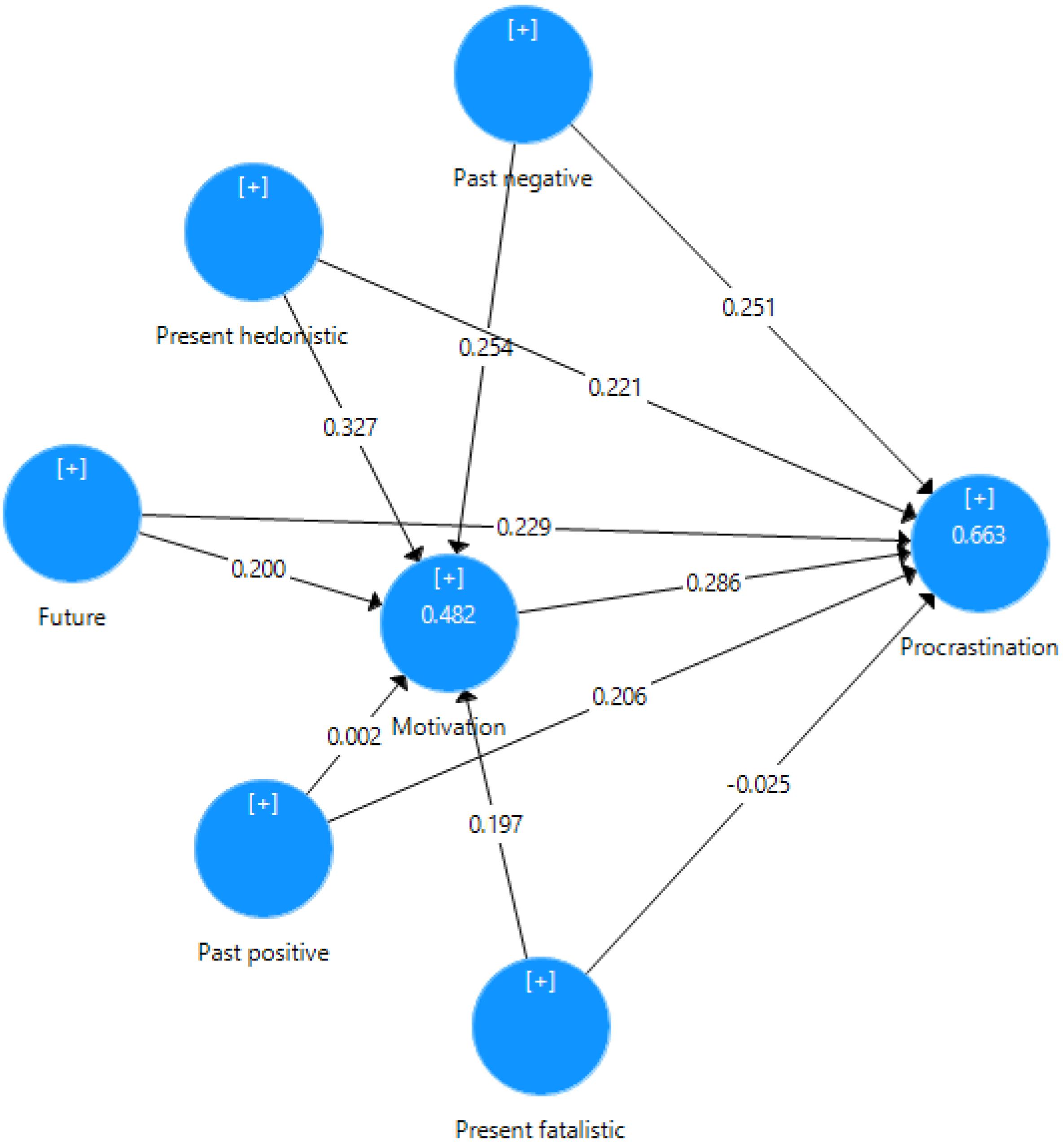
Figure 1.
The tested model of the study based on path coefficients
.
The tested model of the study based on path coefficients
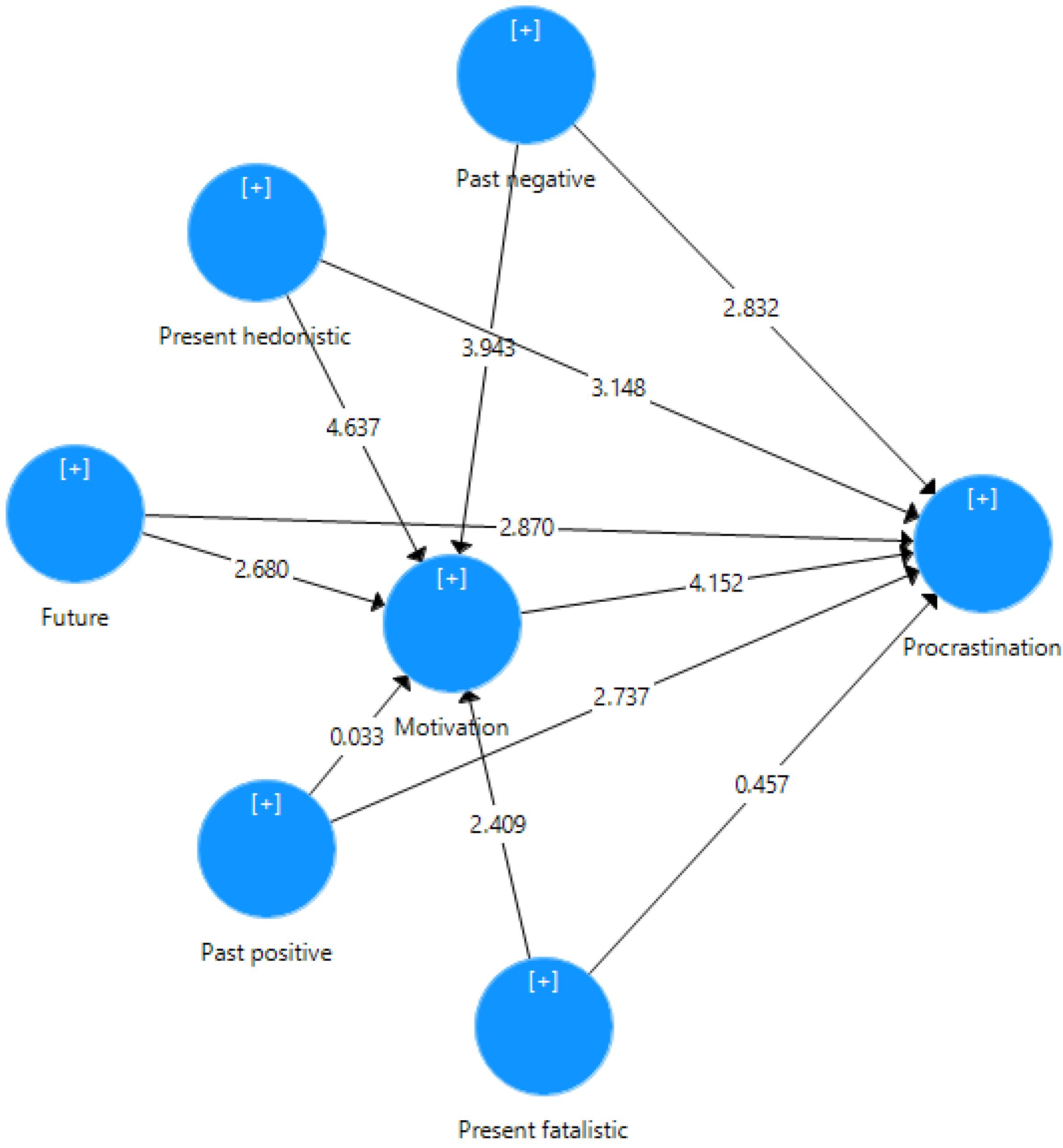
Figure 2.
The tested model of the study based on t-statistics
.
The tested model of the study based on t-statistics
The validity of the model is determined using the coefficient of determination (R-squared). This coefficient measures the amount of variance in an endogenous (dependent) variable that is explained by the exogenous (independent) variables. According to Figure 1, the R-squared value for the mediating variable “Motivation” is 0.482. This means that 48.2% of the changes in the “Motivation” variable are explained by the changes in the variables Past negative, Present hedonistic, Future, Past positive, and Present fatalistic. Additionally, the R-squared value for the dependent variable “Procrastination” is 0.663. This indicates that 66.3% of the changes in the “Procrastination” variable are explained by the changes in the variables Past negative, Present hedonistic, Future, Past positive, Present fatalistic, and Motivation. These R-squared values suggest that the structural model has a good explanatory power. The exogenous variables in the model can account for a substantial portion of the variance in the endogenous variables, providing support for the overall validity and fit of the tested research model. The high R-squared values, together with the previously established reliability and validity of the measurement model, indicate that the structural model is well-specified and can be used to draw meaningful conclusions about the hypothesized relationships among the constructs.
According to the figures and Table 6, except for the components of 6 and 9, all other components are supported at a maximum significance level of 0.05. This is because the t-statistic values for these components are greater than 1.96, and their P values are less than 0.05. Also, among the components, except for the component 8, which is significant at the 0.05 level, the rest of the components are also significant at the 0.01 level. This is because the t-statistic values for these components are greater than 2.58, and their p-values are less than 0.01.
Table 6.
Path coefficients, standard deviations, t-statistics, and P values for the research hypotheses
|
Hypothesis
|
|
Path coefficients
|
Standard deviation
|
T statistics
|
P
values
|
| 1 |
Future - > Motivation |
0.200 |
0.050 |
2.680 |
0.007 |
| 2 |
Future - > Procrastination |
0.229 |
0.048 |
2.870 |
0.005 |
| 3 |
Motivation - > Procrastination |
0.286 |
0.049 |
4.152 |
0.000 |
| 4 |
Past negative - > Motivation |
0.254 |
0.044 |
3.943 |
0.000 |
| 5 |
Past negative - > Procrastination |
0.251 |
0.043 |
2.832 |
0.006 |
| 6 |
Past positive - > Motivation |
0.002 |
0.065 |
0.033 |
0.974 |
| 7 |
Past positive - > Procrastination |
0.206 |
0.041 |
2.737 |
0.007 |
| 8 |
Present fatalistic - > Motivation |
0.197 |
0.049 |
2.409 |
0.023 |
| 9 |
Present fatalistic - > Procrastination |
-0.025 |
0.055 |
0.457 |
0.648 |
| 10 |
Present hedonistic - > Motivation |
0.327 |
0.051 |
4.637 |
0.000 |
| 11 |
Present hedonistic - > Procrastination |
0.221 |
0.050 |
3.148 |
0.002 |
Based on the information provided, to test the significance of the indirect (mediated) causal relationships, the Sobel test was utilized. The Sobel test statistic is calculated as follows:
Where a is the path coefficient from the independent variable to the mediator and b is the path coefficient from the mediator to the dependent variable. Sa and Sb represent standard error of path coefficients of a and b, respectively. If the absolute value of Z is greater than 1.96, the indirect effect of the independent variable on the dependent variable through the mediator is statistically significant at the 95% confidence level. Also, If the absolute value of Z is greater than 2.58, the indirect effect is statistically significant at the 99% confidence level. The results of this test for the case 4 are represented in Table 7.
Table 7.
Sobel test results for indirect causal relationships
|
Relation
|
Future ->Motivation ->Procrastination
|
Result
|
|
Variable
|
Value
|
Z-value
|
| 1 |
a |
0.200 |
3.267** |
Accept |
| b |
0.286 |
| Sa |
0.050 |
| Sb |
0.049 |
|
|
Past negative ->Motivation ->Procrastination
|
Result
|
|
Variable
|
Value
|
Z-value
|
| 2 |
a |
0.254 |
4.074** |
Accept |
| b |
0.286 |
| Sa |
0.044 |
| Sb |
0.049 |
|
|
Past positive ->Motivation ->Procrastination
|
Result
|
|
Variable
|
Value
|
Z-value
|
| 3 |
a |
0.002 |
0.030 |
Reject |
| b |
0.286 |
| Sa |
0.065 |
| Sb |
0.049 |
|
|
Present fatalistic ->Motivation ->Procrastination
|
RESULT
|
|
Variable
|
Value
|
Z-value
|
| 4 |
a |
0.197 |
3.279** |
Accept |
| b |
0.286 |
| Sa |
0.049 |
| Sb |
0.049 |
|
|
Present hedonistic ->Motivation->Procrastination
|
Result
|
|
Variable
|
Value
|
Z-value
|
| 5 |
a |
0.327 |
4.288** |
Accept |
| b |
0.286 |
| Sa |
0.051 |
| Sb |
0.049 |
**It is about the Z value of the indirect relationship among future time orientation, procrastination with the mediation of motivation
The results of the Sobel tests are presented in Table 7. For the indirect relationships, the absolute values of Z were found to be 3.267, 4.074, 3.279, and 4.288 respectively, all of which exceeded the critical value of 2.58. This indicates that the indirect effects of the independent variables Future, Past Negative, Present Fatalistic, and Present Hedonistic on the dependent variable Procrastination, through the mediating variable Motivation, are statistically significant at the 99% confidence level. However, for the indirect relationship between past positive on procrastination via the mediator of motivation, the absolute value of Z equals 0.030 which was less than the critical value of 1.96. Therefore, the indirect effect of the independent variable Past Positive on Procrastination, via the mediator Motivation, was not found to be statistically significant.
The Q2 statistic is the second key index for evaluating the model fit and predictive relevance of the structural model. The Q2 measure was introduced by Stone and Geisser in 1975 to assess the model’s predictive power for the endogenous (dependent) constructs. According to Stone and Geisser, models with acceptable structural fit should also demonstrate predictive relevance for the endogenous variables in the model. The rationale is that if the relationships between the constructs are properly specified in the model, the constructs should have sufficient explanatory power over one another. This, in turn, should lead to the hypotheses being properly supported. If the value of the Q2 index is positive, it indicates that the fit of the model is favorable and the model has good predictive power. Blindfolding technique is used to calculate the Q2 index. This technique provides two values, which are represented as CV-Com and CV-Red in the figure. Cross-validated redundancy value (CV-Red) is used as an estimate of Stone-Geiser index. The results of these indicators for the model of this section are given in Table 8.
Table 8.
CV-Red and CV-Com values for the model’s variables
|
|
Redundancy (CV-Red)
|
Communality (CV-Com)
|
| Future |
|
0.365 |
| Motivation |
0.453 |
0.410 |
| Past negative |
|
0.324 |
| Past positive |
|
0.386 |
| Present fatalistic |
|
0.364 |
| Present hedonistic |
|
0.359 |
| Procrastination |
0.402 |
0.457 |
According to Table 8 as the value of the CV-Red index is positive for all endogenous variables, so, the model has good predictive power.
In SEM using the PLS method, there is no index to measure the whole model, however, an index called goodness of fit (GOF) can be measured. This index considers both measurement and structural models and is used as a criterion to measure the overall performance of the model.
This index is calculated manually using the mean of R2 and the average of communality values. This index is the square root of the product of average communality values and the average coefficient of determination (R square). Because this value depends on the two mentioned indicators, the limits of these two indices are between zero and one, and introduced three values of 0.1, 0.25 and 0.36 as weak, medium and strong values for GOF, respectively. The communality values are presented in Table 8.
The average value of the communality values index is calculated according to the following formula, where Communality value calculated for the research model is equal to 0.380
The average value of the coefficient of determination index is calculated according to the number of endogenous variables of the model according to the following formula, where the calculated R2 for the research model is equal to 0.573.
Moreover, GOF is equal to 0.438. Consequently, the model has strong utility.
Discussion
This study aimed to explore the intricate and multifaceted relationships between time perspectives, motivation, and procrastination, three critical factors that significantly influence learning and personal development. Utilizing SEM analysis, the research revealed that various dimensions of time perspective exert distinct effects on both motivation and procrastination behaviors among individuals.
The results of the study suggest that motivation plays a crucial mediating role in several of the hypothesized relationships. Specifically, a positive association was found between future time perspective and both motivation and procrastination. This finding indicates that having a strong orientation toward the future can serve as both a facilitator and a hindrance to goal-directed behavior. On one hand, learners who maintain a future time perspective may feel inspired and driven to work diligently toward their long-term goals, envisioning the rewards that await them. On the other hand, this same future focus may lead to procrastination, as individuals might prioritize anticipated future rewards over the immediate tasks at hand. This duality highlights a complex dynamic where the anticipation of future success can sometimes result in the delay of present responsibilities.8
Interestingly, the study found that a past negative time perspective emerged as a positive predictor of both motivation and procrastination. This suggests that individuals who harbor a pessimistic view of their past experiences may experience a paradoxical effect: while such negative reflections can enhance their drive to improve and compensate for previous shortcomings, they can also lead to procrastination as a means of avoiding the discomfort associated with past failures. This duality implies that negative past experiences may fuel a desire to achieve, yet simultaneously create a tendency to delay action in the face of perceived challenges.
In contrast, the study revealed that a past positive time perspective did not demonstrate a significant relationship with motivation. This finding suggests that a nostalgic attitude toward past experiences may not directly influence a learner’s drive or goal-directed behaviors. However, it is noteworthy that a past positive perspective was positively associated with procrastination. This indicates that pleasant recollections of the past could lead individuals to procrastinate, potentially as a strategy to escape present challenges and responsibilities in favor of indulging in the comfort of positive memories.48
Furthermore, the research identified a positive link between present hedonistic orientation and both motivation and procrastination. This relationship can be understood in light of the double-edged nature of a pleasure-seeking, live-for-the-moment mindset. While such an orientation can enhance motivation to pursue enjoyable activities, it may also contribute to procrastination as individuals prioritize immediate pleasures over long-term goals.49
Conversely, the present fatalistic perspective was positively associated with motivation but showed no significant relationship with procrastination. This finding can be interpreted as suggesting that a pessimistic view of the present may foster a sense of drive and urgency to achieve, without necessarily influencing an individual’s tendency to delay or avoid responsibilities. This aligns with the idea that individuals may feel compelled to act despite a negative outlook on their current circumstances.
The findings of this study are consistent with the work of Tisocco and Liporace,50 who highlighted the mediating role of motivation in reducing procrastination among university students. Additionally, the results resonate with the research conducted by Khooei-Oskooei et al,51 which suggested that procrastination could yield constructive consequences for EFL learners. In that context, procrastination may drive learners to develop and apply various strategies to cope with challenges and difficulties, ultimately enhancing their language learning abilities.
The findings offer several important implications for both theory and practice. From a theoretical standpoint, the validated mediation model highlights the central role of motivation in shaping procrastination behaviors. This may be helpful for ESP practitioners, policy makers, and ESP students e.g. medical students to understand the nature of challenges and difficulties in learning English and pave the way for some practical strategies to deal with them. ESP Teachers should consider incorporating diverse teaching materials that cater specifically to the interests and motivations of medical students, such as case studies, medical journals, and real-life scenarios. Also, ESP teachers should implement a variety of motivational strategies that align with the distinct needs and preferences of their students. This could involve incorporating group work, interactive activities, and opportunities for practical application of language skills relevant to the medical field. Furthermore, Given the changing dynamics in education and the healthcare field, ESP teachers should remain open to ongoing research to identify emerging motivational factors among students. Continually adapting teaching practices based on student feedback and research findings can lead to more effective learning outcomes. The results suggest that interventions aimed at reducing procrastination should consider targeting individuals’ time perspectives and their associated motivational states. By fostering a balanced time perspective and enhancing intrinsic motivation, individuals may be better equipped to overcome the tendency to procrastinate. Future research should explore some other mediating variables that may further explore the complex interplay between time perspectives, motivation, and procrastination.
Conclusion
The findings of the study highlighted the complex relationships between various time perspectives, motivation, and procrastination. The results demonstrate that certain time orientations have a significant influence on procrastination through the mediating role of motivation. The research utilizes SEM to explore how different dimensions of time perspective—future, past, and present—affect motivation and procrastination behaviors. It highlights the dual role of future orientation in inspiring goal-directed efforts while also contributing to procrastination. The study reveals that a past negative time perspective can enhance motivation to improve but may also lead to procrastination as individuals avoid discomfort from past failures. In contrast, a past positive perspective tends to encourage procrastination by drawing individuals into comforting memories. Additionally, a present hedonistic orientation is linked to both motivation and procrastination, indicating that a pleasure-seeking mindset can lead to engagement in enjoyable activities while delaying task completion. Conversely, a present fatalistic perspective fosters motivation without significantly impacting procrastination. These findings reinforce the mediating role of motivation in managing procrastination and suggest that interventions should focus on addressing time perspectives and motivational states to help students overcome procrastination effectively.
The study focused specifically on Iranian ESP students within a medical context. This narrow demographic may limit the generalizability of the findings to other populations, educational levels, or cultural contexts. Different cultural attitudes toward time, motivation, and procrastination may yield different results in other settings. Also, the study primarily focused on internal time perspectives and motivation, potentially overlooking external factors (e.g., teaching methods, peer influences, institutional support) that could impact procrastination behaviors. Addressing these variables in future research could provide a more holistic understanding of the issue.
Competing Interests
The authors declare no conflict of interest.
Ethical Approval
This study followed BERA’s (2018) ethical guidelines; participants were informed of the research aims and consented to participate. They were informed of the likelihood of publication and were offered anonymity and the opportunity to question, comment on, and withdraw from the research.
Acknowledgements
The authors of this project appreciate the students of Tabriz University of Medical Sciences, Iran, for their cooperation in conducting this research. This study is based on the PHD dissertation approved by Islamic Azad University, Tabriz Branch.
References
- Hutchinson T, Waters A. English for Specific Purposes. Cambridge University Press; 1987.
- Ibrahim AI. ESP at the tertiary level: current situation, application and expectation. Engl Lang Teach 2010; 3(1):200-4. [ Google Scholar]
- Joshani-Shirvan S. Impact of Learner-Centered Teaching and Learning Process on Pre-Advanced First Year Medical Students’ Performance, Attitudes, and Retention in Medical English [dissertation]. Turkey: Middle East Technical University; 2008.
- Faraj BM. English for medical education in EFL context. J Teach Engl Spec Acad Purposes 2015; 3(1):121-48. [ Google Scholar]
- Mahmoodi H, Haddad Narafshan M. Identity types and learners’ attitudes in language learning: voices from students of medical sciences. Res Dev Med Educ 2020; 9(1):17. doi: 10.34172/rdme.2020.017 [Crossref] [ Google Scholar]
- Milosavljević N. Interrelationship between learning English language and students’ medical education. Srp Arh Celok Lek 2008; 136(7-8):441-4. [ Google Scholar]
- Bosher S, Smalkoski K. From needs analysis to curriculum development: designing a course in health-care communication for immigrant students in the USA. English for Specific Purposes 2002; 21(1):59-79. doi: 10.1016/s0889-4906(01)00002-3 [Crossref] [ Google Scholar]
- Huang H, Ding Y, Liang Y, Zhang Y, Peng Q, Wan X. The mediating effects of coping style and resilience on the relationship between parenting style and academic procrastination among Chinese undergraduate nursing students: a cross-sectional study. BMC Nurs 2022; 21(1):351. doi: 10.1186/s12912-022-01140-5 [Crossref] [ Google Scholar]
- Bekleyen N. Understanding the academic procrastination attitude of language learners in Turkish universities. Educ Res Rev 2017; 12(3):108-15. [ Google Scholar]
- Chu AH, Choi JN. Rethinking procrastination: positive effects of “active” procrastination behavior on attitudes and performance. J Soc Psychol 2005; 145(3):245-64. doi: 10.3200/socp.145.3.245-264 [Crossref] [ Google Scholar]
- Cyril AV. Time management and academic achievement of higher secondary students. J Sch Educ Technol 2015; 10(3):38-43. [ Google Scholar]
- Dörnyei Z, Skehan P. Individual differences in second language learning. In: Doughty CJ, Long MH, eds. The Handbook of Second Language Acquisition. John Wiley & Sons; 2003. p. 589-630. doi: 10.1002/9780470756492.ch18
- Dörnyei Z. New themes and approaches in second language motivation research. Annu Rev Appl Linguist 2001; 21:43-59. doi: 10.1017/S0267190501000034 [Crossref] [ Google Scholar]
- Gardner MP. Mood states and consumer behavior: a critical review. J Consum Res 1985; 12(3):281-300. doi: 10.1086/208516 [Crossref] [ Google Scholar]
- Goodman S, Jaffer T, Keresztesi M, Mamdani F, Mokgatle D, Musariri M. An investigation of the relationship between students’ motivation and academic performance as mediated by effort. S Afr J Psychol 2011; 41(3):373-85. doi: 10.10520/ejc98646 [Crossref] [ Google Scholar]
- Akpur U. Predictive and explanatory relationship model between procrastination, motivation, anxiety and academic achievement. Eurasian J Educ Res 2017; 17(69):221-40. [ Google Scholar]
- Klassen RM, Ang RP, Chong WH, Krawchuk LL, Huan VS, Wong IY. Academic procrastination in two settings: motivation correlates, behavioral patterns, and negative impact of procrastination in Canada and Singapore. Appl Psychol 2010; 59(3):361-79. doi: 10.1111/j.1464-0597.2009.00394.x [Crossref] [ Google Scholar]
- Solomon LJ, Rothblum ED. Academic procrastination: frequency and cognitive-behavioral correlates. J Couns Psychol 1984; 31(4):503-9. doi: 10.1037/0022-0167.31.4.503 [Crossref] [ Google Scholar]
- Akbay SE, Gizir CA. Academic procrastination behavior in university students by gender: the role of academic motivation, academic self-efficacy and academic commitment. Mersin Univ J Fac Educ 2010; 6(1):60-78. [ Google Scholar]
- Lewin K. Intention, will and need. In: Rapaport D, ed. Organization and Pathology of Thought: Selected Sources. Columbia University Press; 1951.p. 95-153. doi: 10.1037/10584-005
- Carstensen LL, Isaacowitz DM, Charles ST. Taking time seriously A theory of socioemotional selectivity. Am Psychol 1999; 54(3):165-81. doi: 10.1037//0003-066x.54.3.165 [Crossref] [ Google Scholar]
- Frank LK. Projective methods for the study of personality. J Psychol 1939; 8(2):389-413. doi: 10.1080/00223980.1939.9917671 [Crossref] [ Google Scholar]
- Levine R. Financial development and economic growth: views and agenda. J Econ Lit 1997; 35(2):688-726. [ Google Scholar]
- Zimbardo PG, Boyd JN. Putting time in perspective: a valid, reliable individual-differences metric. In: Stolarski M, Fieulaine N, van Beek W, eds. Time Perspective Theory; Review, Research and Application: Essays in Honor of Philip G Zimbardo. Cham: Springer International Publishing; 2015. p. 17-55. doi: 10.1007/978-3-319-07368-2_2
- Nasrullah S, Khan MS. The impact of time management on the students’ academic achievements. J Lit Lang Linguist 2015; 11:66-71. [ Google Scholar]
- Rothblum ED, Solomon LJ, Murakami J. Affective, cognitive, and behavioral differences between high and low procrastinators. J Couns Psychol 1986; 33(4):387-94. doi: 10.1037/0022-0167.33.4.387 [Crossref] [ Google Scholar]
- Wessel J, Bradley GL, Hood M. A low‐intensity, high‐frequency intervention to reduce procrastination. Appl Psychol 2021; 70(4):1669-90. doi: 10.1111/apps.12293 [Crossref] [ Google Scholar]
- Pinxten M, De Laet T, Van Soom C, Peeters C, Langie G. Purposeful delay and academic achievement A critical review of the Active Procrastination Scale. Learn Individ Differ 2019; 73:42-51. doi: 10.1016/j.lindif.2019.04.010 [Crossref] [ Google Scholar]
- Naderi K, Neshat Doost HT, Talebi H. Evaluating the effectiveness of self-regulation strategy training on procrastination, happiness and academic achievement. J Clin Res Paramed Sci 2021; 10(1):e100923. doi: 10.5812/jcrps.100923 [Crossref] [ Google Scholar]
- Abramowski A. Is procrastination all that “bad”? A qualitative study of academic procrastination and self-worth in postgraduate university students. J Prev Interv Community 2018; 46(2):158-70. doi: 10.1080/10852352.2016.1198168 [Crossref] [ Google Scholar]
- Kazemi M, Fayyazi M, Kaveh M. Investigation of procrastination prevalence and its causes among university managers and employees. Journal of Management Research 2010; 2(4):42-63. [ Google Scholar]
- Gardner RC. Motivation and second language acquisition. Porta Linguarum 2007; 8:9-20. doi: 10.30827/Digibug.31616 [Crossref] [ Google Scholar]
- Khansir AA, Ghan Dehkordi F. The role of motivation in teaching and learning English. Modern Journal of Language Teaching Methods 2017; 7(9):72-85. [ Google Scholar]
- Demirdag S. School principals’ instructional leadership as a predictor of teacher motivation. J Educ Issues 2021; 13(2):6. [ Google Scholar]
- Steel P, Klingsieck KB. Academic procrastination: Psychological antecedents revisited. Aust Psychol 2016; 51(1):36-46. doi: 10.1111/ap.12173 [Crossref] [ Google Scholar]
- Lay CH. At last, my research article on procrastination. J Res Pers 1986; 20(4):474-95. doi: 10.1016/0092-6566(86)90127-3 [Crossref] [ Google Scholar]
- Pychyl TA, Lee JM, Thibodeau R, Blunt A. Five days of emotion: an experience sampling study of undergraduate student procrastination. J Soc Behav Pers 2000; 15(5):239-54. [ Google Scholar]
- Burka JB, Yuen LM. Procrastination: Why You Do it and What to Do About it Now. Cambridge: Da Capo Press; 2008.
- Cao L. Differences in procrastination and motivation between undergraduate and graduate students. J Scholarsh Teach Learn 2012; 12(2):39-64. [ Google Scholar]
- Kim KR, Seo EH. The relationship between procrastination and academic performance: a meta-analysis. Pers Individ Dif 2015; 82:26-33. doi: 10.1016/j.paid.2015.02.038 [Crossref] [ Google Scholar]
- Steel P. The nature of procrastination: a meta-analytic and theoretical review of quintessential self-regulatory failure. Psychol Bull 2007; 133(1):65-94. doi: 10.1037/0033-2909.133.1.65 [Crossref] [ Google Scholar]
- Lee E. The relationship of motivation and flow experience to academic procrastination in university students. J Genet Psychol 2005; 166(1):5-14. doi: 10.3200/gntp.166.1.5-15 [Crossref] [ Google Scholar]
- Kandemir M. Reasons of academic procrastination: self-regulation, academic self-efficacy, life satisfaction and demographics variables. Procedia Soc Behav Sci 2014; 152:188-93. doi: 10.1016/j.sbspro.2014.09.179 [Crossref] [ Google Scholar]
- Cavusoglu C, Karatas H. Academic procrastination of undergraduates: Self-determination theory and academic motivation. The Anthropologist 2015; 20(3):735-43. doi: 10.1080/09720073.2015.11891780 [Crossref] [ Google Scholar]
- British Educational Research Association (BERA). Ethical Guidelines for Educational Research. London: BERA; 2018.
- Ary D, Jacobs LC, Sorensen C, Razavieh A. Introduction to Research in Education. 8th ed. Canada: Wadsworth Cengage Learning. 2010.
- Gefen D, Straub D. A practical guide to factorial validity using PLS-graph: tutorial and annotated example. Commun Assoc Inf Syst 2005; 16(1):91-109. doi: 10.17705/1cais.01605 [Crossref] [ Google Scholar]
- Codina N, Castillo I, Pestana JV, Valenzuela R. Time perspectives and procrastination in university students: exploring the moderating role of basic psychological need satisfaction. BMC Psychol 2024; 12(1):5. doi: 10.1186/s40359-023-01494-8 [Crossref] [ Google Scholar]
- Díaz-Morales JF. Procrastinación: una revisión de su medida y sus correlatos. Rev Iberoam Diagn Eval Psicol 2019; 2(51):43-60. [ Google Scholar]
- Tisocco F, Liporace MF. Structural relationships between procrastination, academic motivation, and academic achievement within university students: a self-determination theory approach. Innov High Educ 2023; 48(2):351-69. doi: 10.1007/s10755-022-09622-9 [Crossref] [ Google Scholar]
- Khooei-Oskooei S, Ahangari S, Seifoori Z. Iranian EFL teachers’ perceptions regarding language learners’ procrastination. Journal of Foreign Language Research 2022; 12(1):15-30. doi: 10.22059/jflr.2021.328577.875 [Crossref] [ Google Scholar]