Res Dev Med Educ. 14:33339.
doi: 10.34172/rdme.025.33339
Original Article
The mediating role of resilience in the relationship between mental health literacy and psychological distress among medical sciences students
Yasamin Kashighandi Conceptualization, Data curation, Investigation, Methodology, Project administration, Software, Writing – original draft, , * 
Jalil Babapour Conceptualization, Methodology, Resources, Supervision, Writing – review & editing,
Author information:
Department of Psychology, The University of Tabriz, Tabriz, Iran
Abstract
Background:
Paying attention to medical sciences students’ psychological distress is paramount. Given the importance of this issue, the present research aimed to determine the mediating role of resilience in the relationship between medical sciences students’ mental health literacy and their psychological distress.
Methods:
The present cross-sectional research was a descriptive correlational study examining students at the Guilan University of Medical Sciences in 2024. A total of 230 individuals were selected by the convenience sampling method. The data were collected by Conner-Davidson’s Resilience Scale (CD-RISC), the Mental Literacy Health Questionnaire (MHLQ), and the Depression, Anxiety and Stress Scale (DASS) and analyzed by the SPSS and AMOS software.
Results:
The results revealed the desirable fit of the proposed model. The structural equations outcomes displayed that mental health literacy and resilience influenced psychological distress directly and significantly. Likewise, mental health literacy had a positive, direct, and significant effect on resilience and an indirect effect on psychological distress through the mediation of resilience. In fact, resilience partially mediated mental health literacy and psychological distress.
Conclusion:
It can be generally concluded that mental health literacy affects psychological distress directly and indirectly through resilience.
Keywords: Resilience, Mental health literacy, Psychological distress
Copyright and License Information
© 2025 The Author(s).
This is an Open Access article distributed under the terms of the Creative Commons Attribution License (
http://creativecommons.org/licenses/by/4.0/), which permits unrestricted use, distribution, and reproduction in any medium, as long as the original authors and source are cited. No permission is required from the authors or the publishers.
Funding Statement
This research received no specific grant from any funding agency in the public, commercial, or not-for-profit sectors.
Introduction
According to recent reports, mental health problems, such as psychological distress and mental disorders, prevail among postgraduate students evaluated by clinical interviews.1 The transition from high school to university, career-exam educational pressure, lack of family support, and economic factors can give rise to high levels of stress in students and make them feel psychologically distressed.2 Furthermore, a review of previous studies indicates that psychological distress is one of the factors that influence students’ academic failure.3 Infrequent involvement in university activities, weaker individual and social relationships, lower academic performance, higher dropout rates, and suicidal thoughts and behaviors can be the outcomes of psychological stresses during education.4 Besides, psychological distress is often accompanied by job burnout and cognitive and behavioral problems in students.5
Psychological distress is broadly defined as a state of emotional suffering characterized by symptoms of depression (e.g., loss of interest, sadness, hopelessness) and anxiety (e.g., restlessness and feeling tense). It is also accompanied by other physical symptoms 6 Psychological distress is a discomforting state of negative emotions, e.g., anxiety and depression, that can lead to unpleasant outcomes.7 According to the Diagnostic and Statistical Manual of Mental Disorders, 5th Edition (DSM-5), psychological distress is a temporary condition triggered by stress, characterized by symptoms such as anxiety, depression, impaired functioning, behavioral changes, and physical symptoms like sleep disturbances, chronic pain, and fatigue.8 Similarly, psychological distress is considered a transient (not long-term) phenomenon with certain stresses and is characterized by sleep disorders, fluctuations in the eating pattern, headache, constipation, diarrhea, chronic pain, frequent anger arousal, and fatigue.9
Some studies have displayed that mental health literacy negatively correlates with psychological distress.10 High levels of mental health literacy noticeably help diagnose, cope, and prevent mental diseases and psychological distress.11 Thus, improving mental health literacy is used as an efficient step in many countries to reduce and prevent different types of psychological distress.12 Indeed, mental health literacy reflects the knowledge and beliefs that help diagnose, manage, and prevent mental diseases.13 Noroozi et al14 showed that Iranian students possessed a moderate level of mental health literacy. Likewise, Bahrami et al15 revealed that mental health literacy was recognized as a chief factor in promoting youths’ mental health. Thus, despite geographical differences, improving mental health literacy is necessary for all societies, and implementing interventions, e.g., suitable educational programs, seems indispensable.15
Research reflects that high levels of resilience strongly correlate with lower psychological distress and better adjustment to university life.16 Besides, resilience operates as a significant source in developing interventions for preventing and curing psychological distress, such as depression, anxiety, and stress.17 Resilience is considered a crucial mental health indicator that can inhibit the undesirable mental health conditions of individuals exposed to stressors.18 It can be clearly explained that resilience refers to individuals’ positive adjustment and capacity to maintain or recover mental health despite experiencing adversities. In fact, resilience is the brain’s ability to shape experiences.19 and reflects the capacity to adjust positively in hard circumstances or after adversities.17
The mental health literacy level predicts psychological resilience.20 It has been found that resilience is associated with better mental health outcomes.21,22 Although the relationship between resilience and mental health literacy has not been examined extensively, a few studies in this area have displayed a positive correlation between resilience and mental health literacy.23 Accordingly, we can infer that health literacy mediated by high resilience significantly contributes to alleviating psychological distress and mental disorders, though the literature review found no study in this respect. Thus, conducting such studies to identify fundamental factors in the relationship between mental health literacy and psychological distress is paramount. The investigation of respective studies shows the high incidence of psychological distress among students, especially medical sciences students.24 This can play a significant role in their mental health and academic achievement. Considering the significance of this issue and the necessity for identifying fundamental mechanisms in the relationship between mental health literacy and psychological distress, this study sought to determine the mediating contribution of resilience to the relationship between mental health literacy and psychological distress in medical sciences students.
Methods
Population
The statistical population of this descriptive-correlational cross-sectional study comprised students at Guilan University of Medical Sciences in 2024. Inclusion criteria included willingness to participate, provided informed consent, no experience of psychological trauma or acute physical illness within the past six months, and no use of psychiatric medication. Incomplete responses to the questionnaire were considered grounds for exclusion. Before beginning the online questionnaire, participants were presented with a digital informed consent form detailing the study’s objectives, the voluntary nature of participation, the right to withdraw at any stage, confidentiality of responses, and the intended use of the collected data. Participants were asked to review this information carefully and to indicate their consent by clicking the “I agree” button. Only after providing consent could they access the questionnaire. This process ensured that participation was entirely voluntary and based on informed agreement.
Sampling Method
Convenience sampling was employed due to time limitations and ease of access through online platforms. Although this method enabled efficient data collection, it potentially limited the representativeness of the sample, which may affect generalizability.
Sampling Size
A total of 230 students completed the online questionnaires distributed via virtual social networks. Participation was voluntary, and consent was obtained digitally before access to the questionnaire was granted.
Statistical Analysis
Descriptive statistics and correlation analyses were performed in SPSS, while AMOS was used for structural equation modeling (SEM) to assess model fit and mediation effects. A significance level of P < 0.05 was considered. The present cross-sectional research was a descriptive-correlational study following a structural equation modeling approach. The statistical population comprised students in the Guilan University of Medical Sciences in 2024.
Data Collection Instruments
Conner-Davidson Resilience Scale (CD-RISC): CD-RISC, designed by Connor and Davidson, is scored on a 5-point Likert scale, from zero to four. The scores range from zero to 100, and higher scores indicate higher resilience.25 Yu et al reported the convergent validity of this scale with the Multidimensional Scale of Perceived Social Support at 0.44 (r = 0.44) and estimated its reliability by Cronbach’s alpha at 0.89 (α = 0.89).26 Bakhshayesh Eghbali et al translated and validated this scale in Iran. They confirmed its validity by factor analysis and confirmed that its 25 items subsumed under five subscales. The factor loading of all items was > 0.30, and the scale’s internal consistency reliability was estimated by Cronbach’s alpha at 0.94.27
Mental Health Literacy Questionnaire (MHLQ): Developed by Dias et al, MHLQ consists of 29 items scored on a 5-point Likert scale, where scores 5, 4, 3, 2, and 1 belong to the strongly agree, agree, neutral, disagree, and strongly disagree responses. Besides, items 6, 10, 13, 15, 21, and 23 are reversely scored. The total score of the 29 items ranges from 29 to 145, and higher scores in this questionnaire indicate higher mental health literacy.28 Dias et al estimated the internal consistency reliability at 0.74 by measuring the Cronbach alpha coefficient. They also examined validity by confirmatory factor analysis and identified four factors.28
Depression Anxiety and Stress Scale (DASS): DASS, designed by Lovibond and Lovibond, includes 21 items measuring anxiety, depression, and stress symptoms on a Likert scale from zero to three. This questionnaire consists of three subscales: Anxiety, depression, and Stress. Every subscale has seven questions and receives a final score estimated by adding up the scores of its respective items, and the total score is the sum of the scores of the subscale.29 DASS benefits from confirmed validity and reliability with respect to numerous studies in this domain. Considering its convergent validity, the correlation of the depression subscale with Beck’s Depression scale equals 0.74, and the Cronbach alpha coefficient has been estimated at 0.91, 0.84, and 0.90 for the depression, anxiety, and stress subscales.30
Results
A total of 230 individuals participated in this study; however, 226 samples were entered into the final analysis. The examined group had a mean age and standard deviation of 23.4 ± 60.16. Besides, 195 students were female, 67 were male, 154 were single, 72 were married, 99 were employed, and 127 were unemployed. Table 1 presents the central tendency indices and Pearson correlation coefficients between the main variables.
Table 1.
Descriptive statistics and correlation coefficients among study variables
|
Variables
|
Mean
|
SD
|
Skewness
|
Kurtosis
|
1
|
2
|
| 1- DASS |
19.97 |
13.98 |
0.61 |
-0.38 |
1 |
|
| 2- MHLQ |
108.34 |
16.06 |
-0.07 |
-0.48 |
-0.62** |
1 |
| 3- CD-RISC |
66.47 |
12.87 |
0.14 |
0.24 |
-0.58** |
0.48** |
Note: DASS = Depression Anxiety and Stress Scale; MHLQ = Mental Health Literacy Questionnaire; CD-RISC = Connor-Davidson Resilience Scale; SD = Standard deviation.
The data were normally distributed since the skewness and kurtosis indices fell into the ± 2 range. Moreover, the results of the Pearson correlation test revealed that psychological distress had negative and significant relationships with mental health literacy (r = -0.62, P = 0.01) and resilience (r = -0.58, P = 0.01). Likewise, mental health literacy and resilience correlated positively and significantly (r = 0.48, P = 0.01). The bootstrap test and structural equation modeling were used to examine the mediating role of resilience in the relationship between mental health literacy and psychological distress. Before these steps, the autocorrelation in residuals was estimated by Durbin-Watson’s test at 2.04, which was a desirable value. Likewise, there was no collinearity between the predictor variables. The fit indices were presented for structural equations modeling, and the results displayed the desirable fit of the proposed model (χ2 = 38.24, df = 13, P = 0.28, λ2/df = 2.94, CFI = 0.96, GFI = 0.95, TLI = 0.94, RMSEA = 0.06). Figure 1 and Table 2 represent path coefficients.
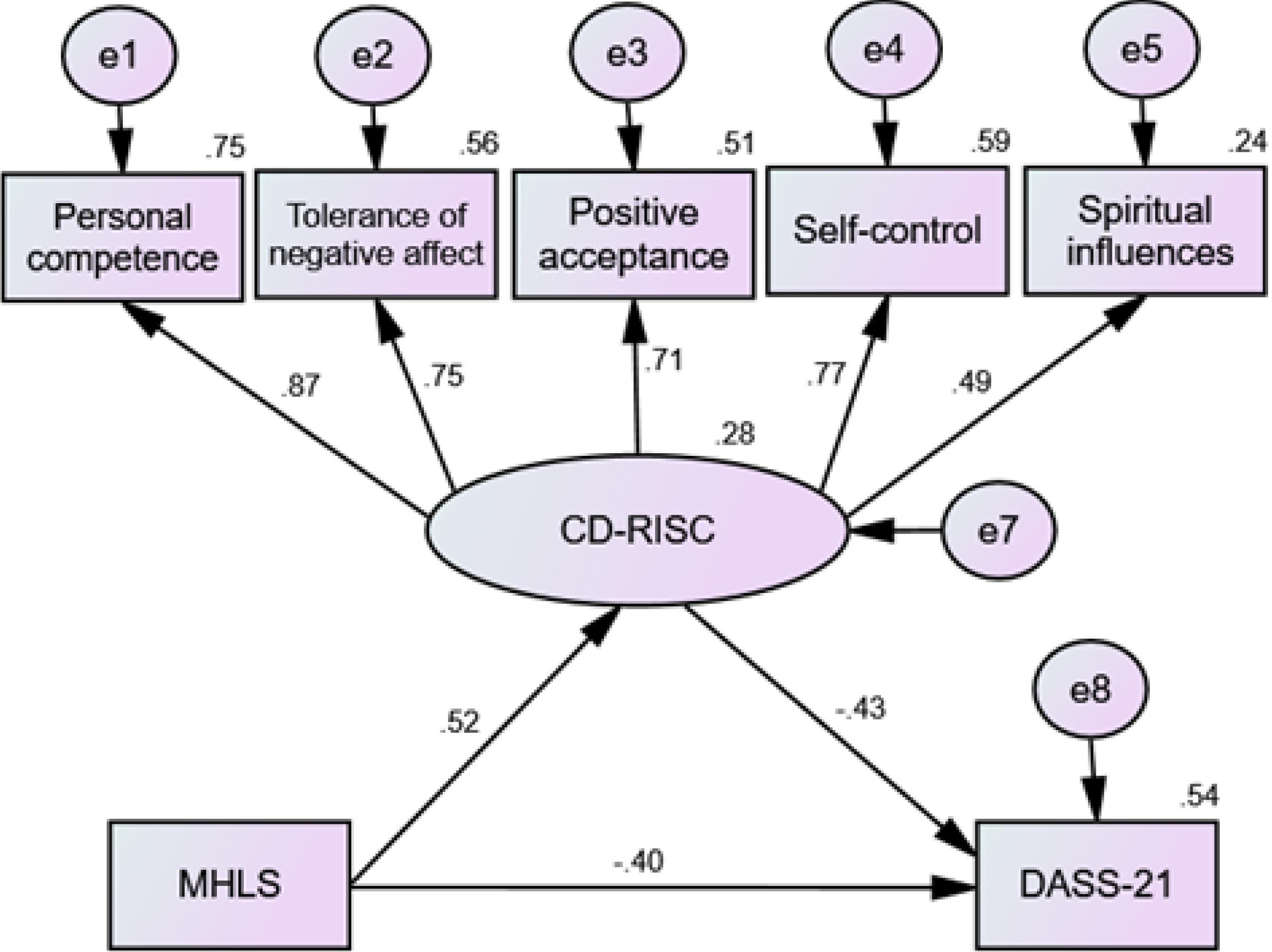
Figure 1.
Structural equation model showing direct and indirect effects. Abbreviations: MHL = Mental Health Literacy, PD = Psychological Distress, RES = Resilience
.
Structural equation model showing direct and indirect effects. Abbreviations: MHL = Mental Health Literacy, PD = Psychological Distress, RES = Resilience
Table 2.
Estimate of direct and indirect effects
|
Path
|
Direct effect
|
CR
|
P
value
|
Indirect effect
|
95% CI -lower bounds
|
95% CI -upper bounds
|
| MHLQ → DASS |
-0.40 |
-7.15 |
0.001 |
-0.23 |
-0.31 |
-0.16 |
| CD-RISC → DASS |
-0.43 |
-6.93 |
0.001 |
- |
- |
- |
| MHLQ → CD-RISC → DASS |
0.52 |
8.14 |
0.001 |
- |
- |
- |
The path analysis results displayed that mental health literacy (β = -0.40, P = 0.01) and resilience (β = 0.43, P = 0.01) had a direct negative and significant effect on psychological distress, and mental health literacy had a direct positive and significant impact on resilience (β = 0.52, P = 0.01). The findings also revealed the indirect effect of mental health literacy on psychological distress through the mediation of resilience (β = 0.23, P = 0.01). Notably, resilience partially mediated the relationship between mental health literacy and psychological distress.
Discussion
This study sought to determine the mediation of resilience in the relationship between mental health literacy and psychological distress among students of medical sciences. The first finding displayed that mental health literacy reduced psychological distress, and students with higher mental health literacy reported lower psychological distress. The present result is in line with the research outcomes of Moss et al,10 Song et al,11 Kelly et al,12 and Sayarifard et al.31 In explaining these outcomes, we can assert that mental health literacy can enhance individuals’ perceptions of mental health problems. It can also decrease psychological distress by promoting knowledge of self-care strategies and awareness of psychological disorders.
The second result demonstrated that mental health literacy was accompanied by increased resilience, i.e., students with higher mental health literacy reported higher resilience. This finding aligns with the research outcomes of Sun et al,20 Finklestein and Laufer,21 Lenzo et al,22 and Özer and Şahin Altun,23 discussed in the introduction. We can explain that mental health literacy provides knowledge enabling individuals to detect mental health-associated problems earlier and appropriately and seek help to prevent symptom exacerbation. Meanwhile, the surge of mental health recedes the stigma caused by mental illness. Thus, when asking for help, individuals are less ashamed and adhere to the treatment more likely. Mental health literacy, in fact, empowers individuals to have more control over their welfare, and this self-confidence is a prerequisite to resilience in mental health management.
According to the third result, resilience reduced psychological distress, and students reporting higher resilience possessed lower psychological distress. This finding agreed with the results of studies by Jia-Yuan et al,16 Connor and Zhang,17 Chmitorz et al,18 and Yasien et al,32 considering the negative association between resilience and psychological distress. We can argue that high levels of resilience in relief forces prevent students from fatigue and burnout and help them maintain their mental health. In addition, collectivism and sociability are among the resilience factors assisting individuals in decreasing their psychological distress. Therefore, implementing resiliency training programs is necessary for individuals’ mental and physical health.
The fourth result displayed the mediating role of resilience in the relationship between mental health literacy and psychological distress, and resilience-mediated mental health literacy significantly contributed to lowering students’ psychological distress. It can be asserted that improvement in mental health literacy helps individuals reach a thorough perception of mental health problems and healthy coping strategies. This knowledge enables them to manage mental health challenges more efficiently and strengthen their resilience to psychological distress. Resilience assists students in adjusting to stresses and barriers and precludes mental discomfort. Resilience is a key element in improving mental health, and can be promoted by educational interventions, e.g., creating a positive environment and providing social support. Hence, students’ mental health literacy lowers the risk of their exposure to psychological distress by enhancing resilience.
The findings of this study indicate that resilience plays a significant mediating role in the relationship between mental health literacy and psychological distress. Accordingly, it is recommended that medical universities incorporate courses aimed at enhancing students’ mental health literacy into their curricula. Additionally, designing skill-based workshops focused on psychological resilience can help reduce students’ psychological distress and prevent academic burnout. These interventions may be particularly effective during high-stress periods such as exams or clinical internships, ultimately promoting the overall mental well-being of students.
Conclusion
This study highlights the mediating role of resilience in the relationship between mental health literacy and psychological distress. Integrating mental health literacy and resilience training into the medical curriculum could serve as a preventive strategy to support students’ psychological health, particularly during high-stress academic periods.
Competing Interests
The authors declare no competing interest.
Ethical Approval
An informed consent form was provided to the participants, and the study protocol was reviewed and ethically approved by the Research Committee of the Department of Psychology.
Acknowledgements
The authors would like to thank the students who participated in this study.
References
- Auerbach RP, Alonso J, Axinn WG, Cuijpers P, Ebert DD, Green JG. Mental disorders among college students in the World Health Organization World Mental Health Surveys. Psychol Med 2016; 46(14):2955-70. doi: 10.1017/s0033291716001665 [Crossref] [ Google Scholar]
- Trigueros R, Padilla A, Aguilar-Parra JM, Mercader I, López-Liria R, Rocamora P. The influence of transformational teacher leadership on academic motivation and resilience, burnout and academic performance. Int J Environ Res Public Health 2020; 17(20):7687. doi: 10.3390/ijerph17207687 [Crossref] [ Google Scholar]
- Noorbala AA, Bagheri Yazdi SA, Hafezi M. Trends in change of mental health status in the population of Tehran between 1998 and 2007. Arch Iran Med 2012; 15(4):201-4. [ Google Scholar]
- Mortier P, Cuijpers P, Kiekens G, Auerbach RP, Demyttenaere K, Green JG. The prevalence of suicidal thoughts and behaviours among college students: a meta-analysis. Psychol Med 2018; 48(4):554-65. doi: 10.1017/s0033291717002215 [Crossref] [ Google Scholar]
- Arbabisarjou A, Hashemi SM, Sharif MR, Haji Alizadeh K, Yarmohammadzadeh P, Feyzollahi Z. The relationship between sleep quality and social intimacy, and academic burn-out in students of medical sciences. Glob J Health Sci 2015; 8(5):231-8. doi: 10.5539/gjhs.v8n5p231 [Crossref] [ Google Scholar]
- Horwitz AV. Outcomes in the sociology of mental health and illness: where have we been and where are we going?. J Health Soc Behav 2002; 43(2):143-51. doi: 10.2307/3090193 [Crossref] [ Google Scholar]
- Gebremedhin HT, Bifftu BB, Lebessa MT, Weldeyes AZ, Gebru TT, Petrucka P. Prevalence and associated factors of psychological distress among secondary school students in Mekelle city, Tigray region, Ethiopia: cross-sectional study. Psychol Res Behav Manag 2020; 13:473-80. doi: 10.2147/prbm.S252779 [Crossref] [ Google Scholar]
- American Psychiatric Association (APA). Diagnostic and Statistical Manual of Mental Disorders: DSM-5. Washington, DC: APA; 2013.
- Horwitz AV. Distinguishing distress from disorder as psychological outcomes of stressful social arrangements. Health (London) 2007; 11(3):273-89. doi: 10.1177/1363459307077541 [Crossref] [ Google Scholar]
- Moss RA, Gorczynski P, Sims-Schouten W, Heard-Laureote K, Creaton J. Mental health and wellbeing of postgraduate researchers: exploring the relationship between mental health literacy, help-seeking behaviour, psychological distress, and wellbeing. High Educ Res Dev 2022; 41(4):1168-83. doi: 10.1080/07294360.2021.1906210 [Crossref] [ Google Scholar]
- Song J, Feng K, Zhang D, Wang S, Wang W, Li Y. The relationship between mental health literacy, overall adaptation and mental health of university freshers. Psychol Res Behav Manag 2023; 16:4935-47. doi: 10.2147/prbm.S437718 [Crossref] [ Google Scholar]
- Kelly CM, Jorm AF, Wright A. Improving mental health literacy as a strategy to facilitate early intervention for mental disorders. Med J Aust 2007; 187(S7):S26-30. doi: 10.5694/j.1326-5377.2007.tb01332.x [Crossref] [ Google Scholar]
- Jorm AF. Jorm AFMental health literacyPublic knowledge and beliefs about mental disorders. Br J Psychiatry 2000; 177:396-401. doi: 10.1192/bjp.177.5.396 [Crossref] [ Google Scholar]
- Noroozi A, Khademolhosseini F, Lari H, Tahmasebi R. The mediator role of mental health literacy in the relationship between demographic variables and health-promoting behaviours. Iran J Psychiatry Behav Sci 2018; 12(2):e12603. doi: 10.5812/ijpbs.12603 [Crossref] [ Google Scholar]
- Bahrami MA, Bahrami D, Chaman-Ara K. The correlations of mental health literacy with psychological aspects of general health among Iranian female students. Int J Ment Health Syst 2019; 13:59. doi: 10.1186/s13033-019-0315-6 [Crossref] [ Google Scholar]
- Jia-Yuan Z, Xiang-Zi J, Yi-Nan F, Yu-Xia C. Emotion management for college students: effectiveness of a mindfulness-based emotion management intervention on emotional regulation and resilience of college students. J Nerv Ment Dis 2022; 210(9):716-22. doi: 10.1097/nmd.0000000000001484 [Crossref] [ Google Scholar]
- Connor KM, Zhang W. Recent advances in the understanding and treatment of anxiety disorders Resilience: determinants, measurement, and treatment responsiveness. CNS Spectr 2006; 11(10 Suppl 12):5-12. doi: 10.1017/s1092852900025797 [Crossref] [ Google Scholar]
- Chmitorz A, Kunzler A, Helmreich I, Tüscher O, Kalisch R, Kubiak T. Intervention studies to foster resilience - a systematic review and proposal for a resilience framework in future intervention studies. Clin Psychol Rev 2018; 59:78-100. doi: 10.1016/j.cpr.2017.11.002 [Crossref] [ Google Scholar]
- Wald J, Taylor S, Asmundson GJ, Jang KL, Stapleton J. Literature Review of Concepts: Psychological Resiliency. Report No.: ADA472961. Defence R&D Canada; 2006. Available from: https://apps.dtic.mil/sti/pdfs/ADA472961.pdf.
- Sun B, Jia Y, Hou J, Liu C. The relationship between mental health literacy and positive coping styles: a moderated mediator. In: The 23rd National Psychology Academic Conference Abstract Collection (Part II); 2021. p. 699-700.
- Finklestein M, Laufer A. Resilience, growth, and posttraumatic symptoms among social workers who are “doubly exposed”. Soc Work Res 2021; 45(4):231-42. doi: 10.1093/swr/svab016 [Crossref] [ Google Scholar]
- Lenzo V, Quattropani MC, Musetti A, Zenesini C, Freda MF, Lemmo D. Resilience contributes to low emotional impact of the COVID-19 outbreak among the general population in Italy. Front Psychol 2020; 11:576485. doi: 10.3389/fpsyg.2020.576485 [Crossref] [ Google Scholar]
- Özer D, Şahin Altun Ö. Nursing students’ mental health literacy and resilience levels: a cross-sectional study. Arch Psychiatr Nurs 2024; 51:222-7. doi: 10.1016/j.apnu.2024.06.017 [Crossref] [ Google Scholar]
- Aghajani Liasi G, Mahdi Nejad S, Sami N, Khakpour S, Ghorbani Yekta B. The prevalence of educational burnout, depression, anxiety, and stress among medical students of the Islamic Azad University in Tehran, Iran. BMC Med Educ 2021; 21(1):471. doi: 10.1186/s12909-021-02874-7 [Crossref] [ Google Scholar]
- Connor KM, Davidson JR. Development of a new resilience scale: the Connor-Davidson Resilience Scale (CD-RISC). Depress Anxiety 2003; 18(2):76-82. doi: 10.1002/da.10113 [Crossref] [ Google Scholar]
- Yu XN, Lau JT, Mak WW, Zhang J, Lui WW, Zhang J. Factor structure and psychometric properties of the Connor-Davidson Resilience Scale among Chinese adolescents. Compr Psychiatry 2011; 52(2):218-24. doi: 10.1016/j.comppsych.2010.05.010 [Crossref] [ Google Scholar]
- Bakhshayesh Eghbali B, Pourramzani A, Bahadivand Chegini AH, Mirniam L, Hasanzadeh K, Saadat S. Validity and reliability of Connor-Davidson Resilience Scale in patients with multiple sclerosis: a psychometric study in Iran. Avicenna J Neuro Psycho Physiology 2022; 9(2):45-50. doi: 10.32592/ajnpp.2022.9.2.100 [Crossref] [ Google Scholar]
- Dias P, Campos L, Almeida H, Palha F. Mental health literacy in young adults: adaptation and psychometric properties of the mental health literacy questionnaire. Int J Environ Res Public Health 2018; 15(7):1318. doi: 10.3390/ijerph15071318 [Crossref] [ Google Scholar]
- Lovibond PF, Lovibond SH. The structure of negative emotional states: comparison of the Depression Anxiety Stress Scales (DASS) with the Beck Depression and Anxiety Inventories. Behav Res Ther 1995; 33(3):335-43. doi: 10.1016/0005-7967(94)00075-u [Crossref] [ Google Scholar]
- Daza P, Novy DM, Stanley MA, Averill P. The Depression Anxiety Stress Scale-21: Spanish translation and validation with a Hispanic sample. J Psychopathol Behav Assess 2002; 24(3):195-205. doi: 10.1023/a:1016014818163 [Crossref] [ Google Scholar]
- Sayarifard A, Ghadirian L, Mohit A, Eftekhar M, Badpa M, Rajabi F. Assessing mental health literacy: what medical sciences students’ know about depression. Med J Islam Repub Iran 2015; 29:161. [ Google Scholar]
- Yasien S, Abdul Nasir J, Shaheen T. Relationship between psychological distress and resilience in rescue workers. Saudi Med J 2016; 37(7):778-82. doi: 10.15537/smj.2016.7.15004 [Crossref] [ Google Scholar]